

Ascot Case Study: Emissions Reporting & Decarbonisation Analysis
Category: Resources
Upload Date: 20/2/2025
Explore our case study detailing how Ascot’s journey to halve emissions by 2030 and achieve Net Zero by 2040 was shaped through data analysis and strategic recommendations.


Insights
Explore our case study detailing how Ascot's journey to halve emissions by 2030 and achieve Net Zero by 2040 was shaped through data analysis and strategic recommendations.
Client: Ascot
Services: Decarbonisation Analysis
Year: 23/24
Background:
Carbon Responsible started working with Ascot in 2021, with the initial project being Scope 1, 2 and 3 emissions measurement. We have then analysed the impact of their low-emissions restaurant Neutro (Royal Ascot 2022) and their Net Zero Village (Royal Ascot 2023), before working on a full decarbonisation strategy analysis in January 2024. Ascot aims to halve their emissions by 2030 and achieve Net Zero by 2040 to align with their commitments as signatories of the United Nations’ Sports for Climate Action Framework. Our case study article highlights how we aided them in developing a strategic roadmap to reach these ambitious environmental targets.
Our Solution:
At Carbon Responsible, we have been working with Ascot since 2021 to calculate their carbon footprint for 2019 and 2020, including very bespoke Scope 3 sources such as racegoers travel, catering freight, and horse freight. In 2022, we started helping them develop a decarbonisation initially focussing on the Royal Ascot events. Hosting approximately 20,000 racegoers across three days, these have seen a year-on-year development having started with a single Net Zero restaurant in 2022. As their carbon accounting partner, we monitor and measure bespoke emissions metrics across their eventing season – encompassing jumps, flats and the flagship meetings.
Strategies in Action
Neutro Restaurant – 2022 Royal Ascot
As part of their Net Zero plan, Ascot opened a low-emissions restaurant (Neutro) during the 2022 Royal Ascot event. Carbon Responsible have calculated the emissions associated with running the Neutro Restaurant and compared them to those of a generic restaurant with the same energy requirements. The result of this analysis was a striking 55% reduction in emissions for the Neutro restaurant compared to the generic restaurant. This was driven by several measures adopted in the Neutro restaurant:
- Locally sourced and plant-based menu
- Upcycled materials used in the build and furniture
- Smart Flower installed to capture solar energy
- HVO (hydrogenated vegetable oil) generators used to replace all fuel consumption
Net Zero Village – 2023 Royal Ascot
Following this project, in the 2023 Royal Ascot event Ascot extended the low-emissions operations to a Net Zero Village, enclosing multiple catering and entertaining stations. Carbon Responsible calculated the emissions of Ascot’s Net Zero Village and compared them with those of a generic village of the same size, where no sustainability measures were taken to reduce its environmental impact. This analysis concluded that the emissions of Ascot’s Net Zero Village are approximately 30% lower than those of the generic village including emissions from customer travel emissions (over which Ascot has minimal control), and about 50% lower excluding the emissions from customer travel. For the Net Zero Village, Ascot have implemented the following measures:
- A battery was used to take the Village off grid. This could potentially allow Ascot to recharge this battery either using renewable energy generated on site, or from the UK grid during off-peak hours, where electricity is produced in excess.
- No non-recyclable or compostable waste was disposed of at the Net Zero Village, thanks to the choice of recyclable or compostable packaging and cutlery.
- The marquees, chairs and tables used at the Village were second-hand, which reduces the emissions related to the production of new materials.
- Ascot employed local people as much as they could and encouraged staff and costumers to travel by public transport or by bike when possible.
- An old van reconditioned with electric ovens was used as a pizza truck.
- 50% of the food sold was plant-based, and drinks were locally sourced.
“Sustainability is a key focus for us at Ascot and we have made great progress to reduce our carbon footprint in the past few years, including the launch of our Net Zero Village Enclosure for the first time in 2023,” comments Jonathan Parker, Managing Director of 1711 by Ascot
Full Decarbonisation Analysis
Ascot plans to adopt energy efficiency and emissions reduction measures to an increasing proportion of the Royal Ascot operations, and to then extend this to other events in the future. Carbon Responsible have provided a decarbonisation analysis to drive strategic decisions to halve Ascot’s emissions by 2030 compared to a 2022 baseline, and to reach Net Zero by 2040. As part of this project, we have described several scenarios and the projected impact up to 2030. These scenarios are meant to guide Ascot’s Net Zero roadmap for the next few years, focussing on those actions that would have a more substantial impact on their emissions.
For each of the scenarios considered, we have provided Ascot with a graph clearly showing what the total emissions are expected to be under that scenario, and where they should be in order for Ascot to align with their short-term target of reducing their emissions by 50% by 2030 from a 2022 baseline. An example of such graphs is shown below.
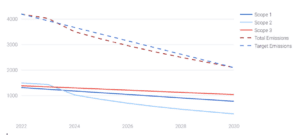
This shows one scenario under which Ascot would align with their short-term Net Zero target by 2030.
The Future of the Ascot Racecourse & Carbon Responsible Partnership
We continue to provide measurement and corporate sustainability reporting while supporting on additional projects such as:
- Board presentation material to leverage investment for ongoing sustainability initiatives and investments. This includes the use of solar power generation in the main grandstand.
- Net zero roadmap development & supporting strategic decision-making
- 2024 emissions reporting & target monitoring
Here’s what our Carbon Analyst, Emma Baldassari had to say about the work and achievements:
“It was great to be working with Keith and Pete in the last few years on Ascot’s emissions reporting and decarbonisation analysis projects, as it has always been evident how much they care about both data integrity and data-driven emission reduction. Ascot are taking the lead in promoting environmental responsibility within the sports industry, and we at Carbon Responsible could not be prouder to be helping them in their journey to Net Zero.”